
Reviewed · WALKING TOURS
Tirana Walking Tour; Guided Small Group
Tirana’s story is written in layers: Ottoman mosques, Italian-era buildings, communist monuments, new cafés, and modern towers all crowd into the same city center. This two-hour walking tour gives you a useful first look, moving from the former communist zone around Blloku to Skanderbeg Square, religious landmarks, Tirana Castle, and the Pyramid.
I like the small group of no more than eight, which gives you room to ask questions. I also like the guides’ focus on daily Albanian life, not just dates and buildings. Markel, Gjergj, Ervin, Ervis, Brikena, and Angjeso have all led recent tours, and the strongest praise centers on their clear explanations and easy conversation.
The main thing to consider is the tight schedule. The tour covers many stops in two hours, so some visits are brief and the walking pace may feel brisk. If you want long museum visits or time inside every monument, you’ll need to explore again on your own.
In This Review
- Key points at a glance
- Why this is a smart first walk in Tirana
- Meeting at the Twin Towers
- Postbllok and Blloku: from surveillance to café life
- The Resurrection of Christ Orthodox Cathedral
- House of Leaves and the communist story
- Skanderbeg Square, the city’s main stage
- Clock Tower and Et’hem Bej Mosque
- Tirana Castle and Toptani’s modern city setting
- Namazgah Mosque and Tirana’s religious mix
- The Pyramid and Park Rinia
- What the guides add to the experience
- Timing, pace, and value at $12
- Who should book this Tirana walk?
- Should you book it?
- FAQ
- How long does the Tirana walking tour last?
- How much does the tour cost?
- Where does the tour begin?
- How do I find the meeting point?
- Where does the tour finish?
- What language is the tour conducted in?
- How large is the group?
- Which landmarks are included?
- Can I cancel for a refund?
Key points at a glance
- A compact route through Tirana’s major sights: See the Pyramid, Skanderbeg Square, the Clock Tower, Et’hem Bej Mosque, Tirana Castle, and more.
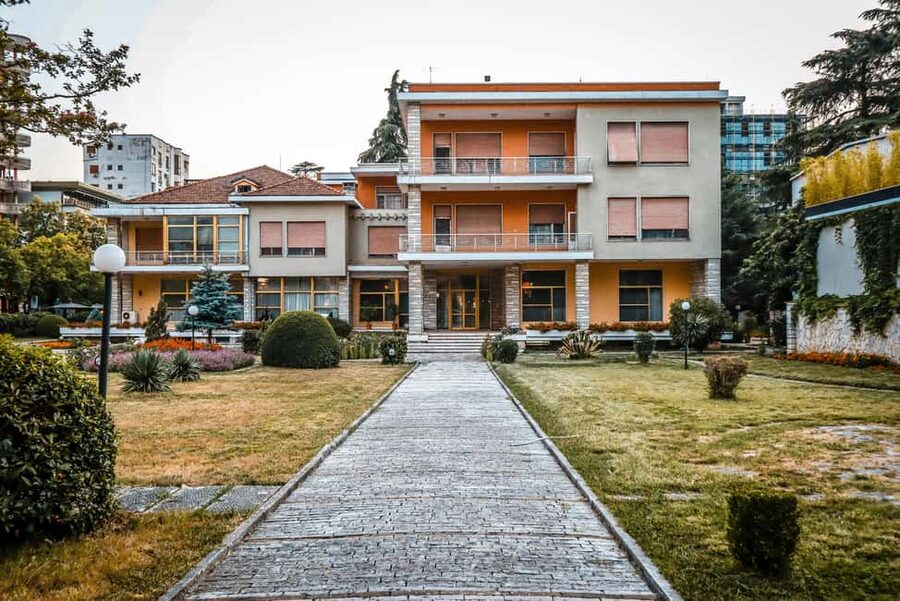
- A useful introduction to Albania’s communist past: The Postbllok memorial and House of Leaves help explain the city’s recent political story.
- A small English-speaking group: With a maximum of eight participants, questions are easier and the guide can keep the tour conversational.
- Several religious traditions in one walk: Visit or pass the Orthodox Cathedral, Et’hem Bej Mosque, and Namazgah Mosque.
- Good local orientation: Your guide can suggest restaurants, coffee spots, and things to do after the walk.
- Strong value at $12: You receive two hours with a local guide, a practical choice for a first morning or afternoon in Tirana.
Why this is a smart first walk in Tirana
Tirana can feel confusing at first. Its center does not present one tidy architectural style. Instead, the city shows Ottoman traces, Italian planning, communist-era concrete, modern commercial buildings, and broad public spaces shaped by newer development.
That mixture is exactly what makes a guided walk useful. You can look at a mosque, a memorial, a government building, or a café district and see only the surface. A local guide can explain how Albania’s political and religious past shaped the city, and how people live with those changes today.
This is not a tour built around one grand monument. It is a city introduction. You move through several neighborhoods and public spaces, picking up a basic timeline of Tirana as you go. I would choose it near the beginning of a stay, then use the guide’s restaurant and sightseeing suggestions to plan the next day or two.
The price also matters. At $12 per person, this is inexpensive for a guided city walk, especially with a group capped at eight. You are paying for context and orientation rather than long indoor visits. That makes the experience a good buy if you want to understand Tirana before exploring it alone.
A few more Tirana trips to weigh up
- Walking Tour of Tirana
★ 5.0 · 646 reviews - Tirana: Express Walking Tour with a Guide
★ 4.8 · 503 reviews - Tirana Center: Magic Walking Tour French/Italian/English Etc
★ 4.9 · 402 reviews
Meeting at the Twin Towers
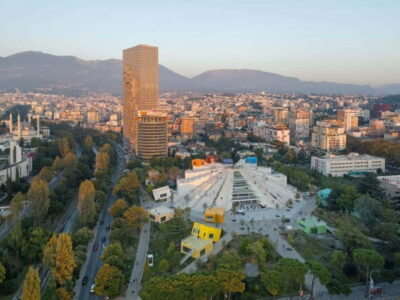
The walk begins at the BKT ATM beside the Twin Towers on Bulevardi Dëshmorët e Kombit. The towers are directly opposite the Pyramid of Tirana, and the meeting point is outside the Amo sushi restaurant on the ground floor of Tower 2.
This is a practical central location, but give yourself a few minutes to find the right side of the buildings. The instructions identify the Twin Towers and the restaurant clearly, so you should not need to search for a separate office or museum entrance.
The route returns to the Twin Towers at the end. That makes the start and finish easy to connect with the nearby central sights. Your guide is English-speaking, and the group remains limited to eight people.
Postbllok and Blloku: from surveillance to café life
One of the first meaningful stops is Postbllok, also called Checkpoint. This memorial area helps introduce Albania’s communist period, a subject that is central to understanding modern Tirana.
The name Blloku refers to a part of the city that once had restricted access for the communist leadership and political elite. Today, it is known for cafés, boutiques, restaurants, and art spaces. The contrast is sharp, and that contrast gives the walk much of its character.
I like this opening because it connects politics with ordinary city life. You are not simply told that Albania changed after communism. You see how a once-closed district became one of Tirana’s most social areas.
The guide may also share details about a notable house in Blloku, an aspect that Markel explained particularly well during one tour. The precise value here is not just the building itself, but the story of who could live in the area and how people understood power in the old system.
Expect around 15 minutes of walking between the first points and Blloku. The route is urban and active, so comfortable shoes are a sensible choice.
The Resurrection of Christ Orthodox Cathedral
The tour then reaches the Resurrection of Christ Orthodox Cathedral. This is one of the clearest places to discuss Albania’s religious identity, especially because the country experienced a long period of official atheism under communist rule.
The visit is short, listed at about 15 minutes including walking. That means you should expect an introduction and a look around rather than a long architectural study.
The cathedral also helps balance the route. After the political story of Postbllok and Blloku, you shift toward faith, public identity, and the way religious buildings returned to daily city life. If learning about Albania’s religious traditions matters to you, listen closely here and at the two mosques later in the walk.
Same coast, a completely different kind of day:
- From Tirana: Bovilla Lake & Gamti Mountain Hiking Day Trip
★ 4.9 · 4,397 reviews - From Tirana: Bovilla Lake & Gamti Mountain Hiking Tour
★ 4.9 · 3,003 reviews - From Tirana: Bovilla Lake & Gamti Mountain Viewpoint Hike
★ 4.8 · 2,053 reviews - Tirana/Durres/Golem: Saranda, Ksamil, Blue Eye Day Trip
★ 4.8 · 1,584 reviews
House of Leaves and the communist story
The House of Leaves Museum is one of the tour’s most important stops. Its subject is surveillance during Albania’s communist era, and it gives the earlier discussion of Postbllok a more personal edge.
The visit and sightseeing time is listed at roughly 10 minutes. That is brief for a museum, so I would not book this walk expecting to see every room or read all the displays in detail. Instead, treat the stop as a guided introduction to the museum and its role in the country’s recent past.
This is where a good guide makes a major difference. Several guides, including Markel and Angjeso, have been praised for explaining history in a clear, engaging way and for answering questions. You can ask about how surveillance affected ordinary people, how Albania changed after communism, or how the subject still shapes public memory.
If the museum catches your interest, plan a separate visit later. The tour gives you a reason to return, but not enough time for a full museum session.
Skanderbeg Square, the city’s main stage
The route continues to Skanderbeg Square, Tirana’s central public space. This is the longest major sightseeing stop, with about 30 minutes for photos, a visit, guided explanation, and general orientation.
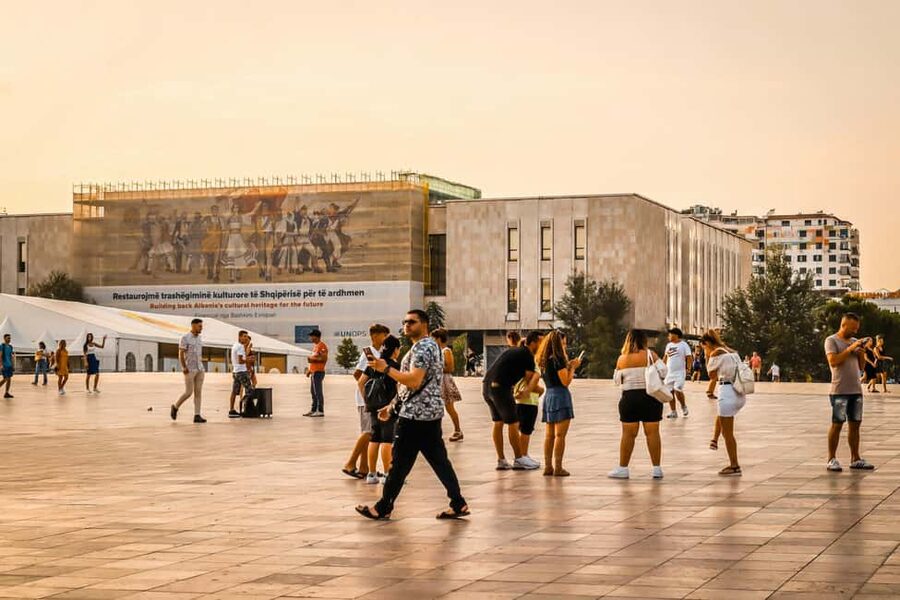
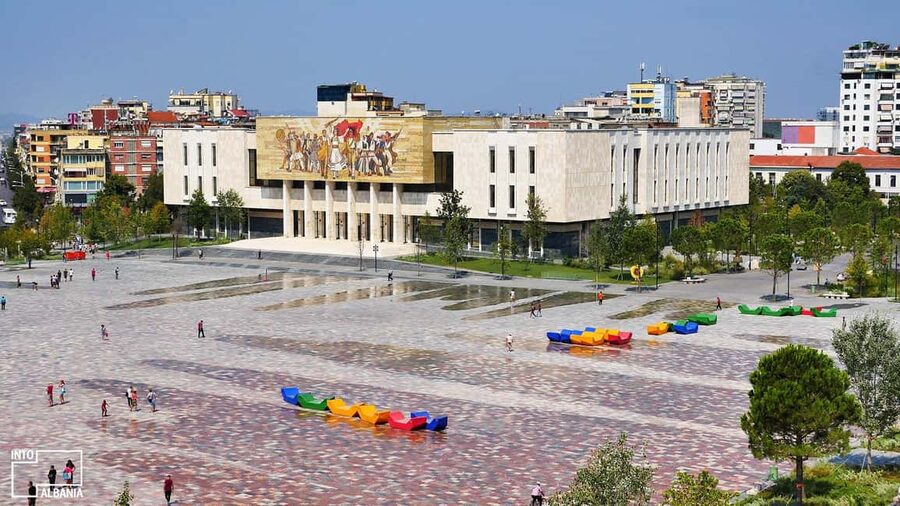
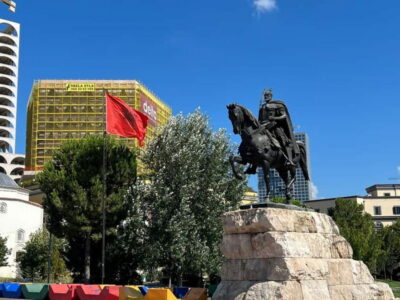
The square is the place to connect many parts of Albania’s national story. The name refers to Skanderbeg, the medieval Albanian military leader whose image is central to national identity. The wide open space also makes it easier to understand how Tirana presents itself as a capital.
Your guide can put the surrounding buildings and monuments into context, rather than leaving you with a collection of impressive facades. This is also a good point to ask practical questions about where to eat, which museums deserve more time, and what to see outside the center.
The square can feel exposed in bad weather, so bring a rain jacket if the forecast looks poor. One recent group continued in the rain and still found the guide’s explanations worthwhile, but weather will affect how comfortable you feel during the photo stops.
Clock Tower and Et’hem Bej Mosque
The Clock Tower of Tirana is next, mainly as a photo stop. It is a short pause, listed at about 10 minutes, so expect a quick explanation and time for pictures.
Nearby, Et’hem Bej Mosque adds another important religious and architectural layer. The route allows about 15 minutes of walking around this part of the center. The mosque is especially useful in the sequence because you have already seen the Orthodox Cathedral and discussed the country’s religious past.
The tour does not present Tirana as a city with one single tradition. Instead, it shows several faiths and public buildings close together. That is a helpful way to understand Albania’s culture without reducing it to one era or one belief system.
As with the cathedral, the time here is limited. You should listen to the guide’s explanation and enjoy the setting, then return later if you want a slower look.
Tirana Castle and Toptani’s modern city setting
The walk proceeds toward Tirana Castle, also referred to in the tour description as Toptani Castle. The route allows around 30 minutes for walking, making this one of the longer transitions.
Do not expect a vast medieval fortress isolated from the city. The castle area is part of central Tirana’s modern urban fabric, which is precisely why it works well on this tour. You see how an old historical reference sits beside shops, restaurants, and newer development.
The castle stop brings together the tour’s main theme: Tirana is a city where older remains and newer life overlap. You can pause for food or coffee suggestions here, and your guide’s local advice may be especially useful because the route has already introduced several central districts.
The walk itself is part of the experience. You are not being driven between disconnected attractions. You get to notice how streets, public spaces, businesses, and monuments fit together.
Namazgah Mosque and Tirana’s religious mix
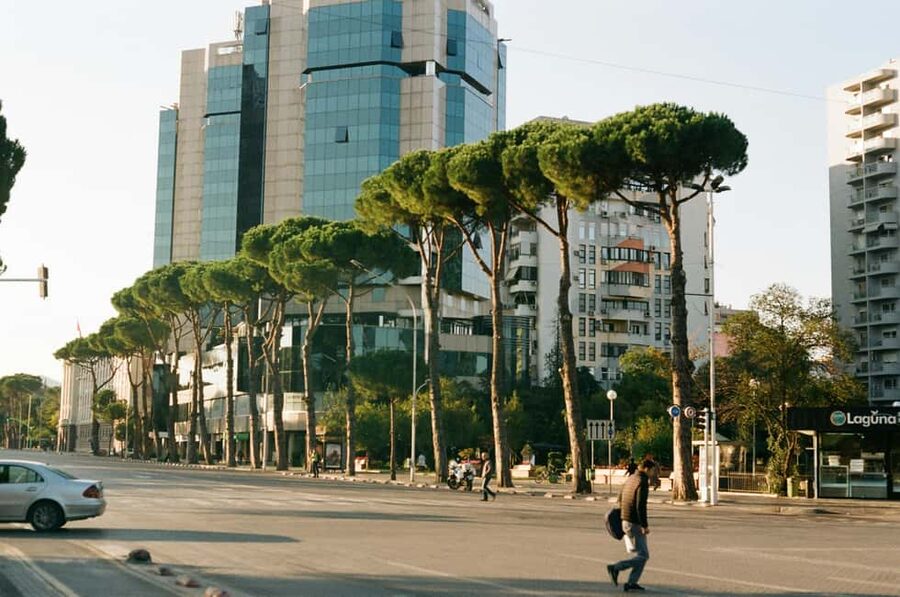
Namazgah Mosque provides another chance to discuss religion and public life in Albania. The stop includes a photo break, sightseeing, and guided explanation, with about 15 minutes assigned to it.
Placed after Et’hem Bej Mosque and the Orthodox Cathedral, it helps form a simple visual map of Tirana’s religious landmarks. The guide can explain the broader cultural setting and help you understand why these buildings matter beyond their appearance.
The stop is short, so think of it as part of a wider conversation rather than a full architectural visit. This is one reason the tour works best as an introduction. You get enough information to recognize the importance of the site, then you can decide which places deserve a longer return visit.
The Pyramid and Park Rinia
The Pyramid of Tirana is one of the route’s most recognizable photo stops. It represents another chapter in the city’s recent story and sits directly opposite the Twin Towers, where the walk begins and ends.
The tour allows about 15 minutes for walking and sightseeing around the Pyramid. You should have time to take photographs and hear why this unusual structure matters to Tirana, but not to spend a long period exploring every part of it.
From there, the walk passes through Park Rinia, with roughly 10 minutes of walking. The park offers a change of pace after the central squares, museums, religious buildings, and busy streets.
Then you return to the Twin Towers. Since the finish is at the starting point, you can use the guide’s final recommendations right away. Ask for a nearby coffee, a restaurant, or another activity that fits your schedule.
What the guides add to the experience
The most consistent strength is the human side of the tour. Guides named in the feedback include Gjergj, Markel, Brikena, Ervin, Ervis, and Angjeso. Their individual styles may differ, but the useful pattern is clear: the tour depends on conversation and explanation, not a long prepared speech delivered without pause.
Markel received praise for explaining Albania’s historical timeline and for sharing a less obvious story connected with a house in Blloku. Brikena was noted for detailed explanations of history and culture, while Ervin was praised for discussing Albanian life as well as the headline sights.
That matters in a group this small. With up to eight people, you can ask a question without trying to interrupt a crowd. One participant even had passport problems before the walk, and the guide waited while those issues were sorted out, a small example of the personal attention possible in a small group.
The tour is conducted in English. If you prefer a quiet walk with little discussion, this may feel talk-heavy. If you want to ask about politics, religion, food, or ordinary life, the format suits you well.
Timing, pace, and value at $12
Two hours is enough to get your bearings, but the route covers a lot. You will see many locations, yet several stops are short. The House of Leaves, the Clock Tower, the cathedral, and the mosques should be treated as compact introductions, not full visits.
The walking sections are also substantial. The itinerary includes several 10 to 30-minute walks, and the full sequence may feel active because the tour keeps moving. Wear shoes you can walk in and keep water with you.
At $12, the balance is favorable. You receive a local English-speaking guide, a small group, historical context, and suggestions for the rest of your stay. The value is strongest for first-time visitors, solo visitors who want company, and anyone who wants to understand the city before choosing which places to revisit.
Free cancellation is available up to 24 hours before the start, and you can reserve without paying immediately. Starting times vary, so check availability when booking.
Who should book this Tirana walk?
I would recommend it to first-time visitors, couples, solo visitors, and families with older children who can manage two hours on foot. It is also useful as a first activity after arriving in Albania because it covers the main center without demanding a full day.
History-minded visitors will get the most from Postbllok and the House of Leaves. Architecture fans will appreciate the jump between Ottoman, Italian, communist, religious, and modern forms. Food-focused visitors should use the final guide recommendations to shape the next part of the day.
I would be more cautious if you want long museum time, a slow photography walk, or a route focused on one period. The schedule is broad rather than deep. You will leave with a working map of Tirana and plenty of questions, which is a good result for a $12 introduction.
Should you book it?
Book this tour if you want a fast, friendly orientation to Tirana with real attention to Albania’s political past, religious life, and daily culture. The small group and strong guide feedback make it a better choice than simply walking between the same sights with no context.
Skip it only if you already know central Tirana well or prefer to explore at your own slow pace. For most first visits, the low price, central route, and chance to ask a local guide direct questions make this a sensible start.
FAQ
How long does the Tirana walking tour last?
The tour lasts two hours.
How much does the tour cost?
The price is $12 per person.
Where does the tour begin?
Meet at the BKT ATM beside the Twin Towers on Bulevardi Dëshmorët e Kombit, Tower 2, Tirana.
How do I find the meeting point?
The Twin Towers are opposite the Pyramid of Tirana. Wait outside the Amo sushi restaurant on the ground floor.
Where does the tour finish?
The walk returns to the BKT ATM at the Twin Towers.
What language is the tour conducted in?
The live tour guide speaks English.
How large is the group?
The group is limited to eight participants.
Which landmarks are included?
The route includes Postbllok, Blloku, the Resurrection of Christ Orthodox Cathedral, House of Leaves Museum, Skanderbeg Square, the Clock Tower, Et’hem Bej Mosque, Tirana Castle, Namazgah Mosque, the Pyramid of Tirana, and Park Rinia.
Can I cancel for a refund?
Yes. You can cancel up to 24 hours in advance for a full refund.
Just added around Tirana
- Zipline Tirana Adventure & Petrela Castle – With Transport★ 4.4 · 10 reviews
- Wine Tasting & Vineyards Escape near Tirana★ 4.9 · 8 reviews
- Wonderful Sunset and Dinner in the Castel Of Petrela★ 4.6 · 4 reviews
- Walking Tour in Tirana, Albania★ 3.7 · 28 reviews
- Vlora, Dhermi & Llogara Day Trip from Durrës or Golem★ 5.0 · 5 reviews
- From Tirana: Mount Dajti Adventure, Local Vibes & Cable Car opt★ 4.5 · 6 reviews
- Winetasting tour in Alpeta winery – Roshnik village by 1001 Albanian Adventures★ 5.0 · 26 reviews
- Day Tour to Petrela Castle and Zip Line Albania Adventure★ 5.0 · 10 reviews
Walking Tours, compared.
Blue Eye Kayak and walking tour & Lekursi Castle
Read our review →

Tirana Stroll Tour, Walk and Taste Qofte & Raki!
Read our review →
Tirana’s Communist Past; Small Group Walking Tour
Read our review →Browse the lists this tour appears in