
Reviewed · WALKING TOURS
Tirana Walking Tour & Bunk’Art 2 entrance
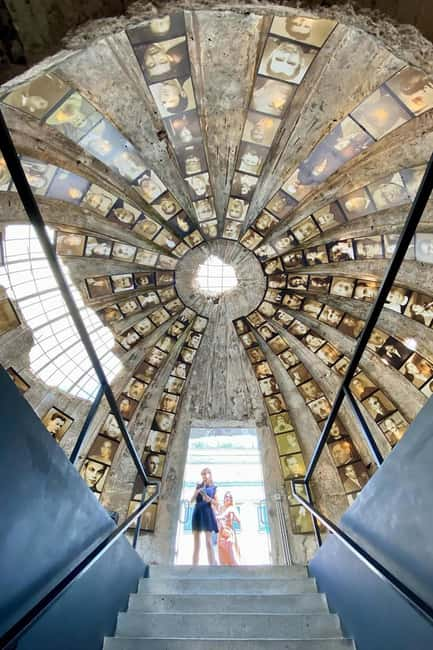
Tirana’s story is packed into a surprisingly walkable center. In three hours, you move from Ottoman mosques and trading bridges to communist bunkers, modern churches, government buildings, and lively cafe districts. The most powerful stop is Bunk’Art 2, where a former underground bunker explains how Albania’s state security system watched, arrested, and punished its own people.
I like the way this tour pairs major sights with less obvious reminders of the past, especially the Tabak Bridge, Postbllok Memorial, House of Leaves, and Enver Hoxha’s former villa. I also like the practical mix of walking and one included museum entrance, with a guide who can explain what you are seeing rather than leaving you to decode Tirana on your own.
The main consideration is pace. Three hours is enough for an excellent first look, but not enough for long visits inside every museum or building named along the route. You will walk a lot, and some stops are viewed from outside or covered briefly.
In This Review
- Key points to know before booking
- A useful first look at Tirana in three hours
- Starting near Rruga George W. Bush
- Bunk’Art 2: the tour’s most serious stop
- Tanners’ Bridge and the Ottoman city
- The Pyramid of Tirana and a difficult legacy
- Mother Teresa Square, the stadium, and the university
- Blloku: from restricted quarter to social center
- Skanderbeg Square and Tirana’s major landmarks
- Churches, government buildings, and memories of communism
- New Bazaar and the everyday city
- Is $35 a fair price?
- Practical advice for the walk
- Who should book this Tirana tour?
- Should you book it?
- FAQ
- How long does the Tirana walking tour last?
- What is included in the price?
- Is transportation included?
- Where does the tour meet?
- What languages are available?
- Is Bunk’Art 2 included?
- What should I bring?
Key points to know before booking
- Bunk’Art 2 gives the tour its strongest historical focus: Allow about an hour for this underground museum on communist-era persecution and state security.
- The route links several eras of Tirana: You pass Ottoman monuments, fascist-period government buildings, communist landmarks, and newer cultural spaces.
- The Clock Tower provides a central Tirana view: Its panoramic outlook helps you understand the layout around Skanderbeg Square.
- You see more than the usual square-and-mosque circuit: The route includes Tanners’ Bridge, the Pyramid, Blloku, Mother Teresa Square, and communist memorials.
- The $35 price includes the guide and Bunk’Art 2 admission: Meals, drinks, transport, and personal costs are extra.
- Comfortable shoes matter: The tour covers substantial ground, and weather can affect how enjoyable the walk feels.
A useful first look at Tirana in three hours
This is a city orientation tour with a clear historical spine. You begin near Rruga George W. Bush, visit Bunk’Art 2, then walk through central Tirana toward the Pyramid, Mother Teresa Square, Blloku, and Skanderbeg Square before returning to the starting area.
The route does not treat Tirana as a single-era capital. You see Ottoman religious buildings, Italian-influenced public architecture, communist monuments, modern cultural centers, and ordinary public spaces where people gather today. That range is the tour’s real value. Instead of learning Tirana as a string of disconnected photo stops, you get a basic sense of how the city changed.
The live guide is available in Albanian, English, and Italian. Elis is specifically praised for clear, engaging explanations and a strong personal interest in the subject. A separate note also describes a friendly female guide who led the group capably. Since the quality of a walking tour depends heavily on who leads it, the guide is an important part of what you are paying for.
A few more Tirana trips to weigh up
- Walking Tour of Tirana
★ 5.0 · 646 reviews - Tirana: Express Walking Tour with a Guide
★ 4.8 · 503 reviews - Tirana Center: Magic Walking Tour French/Italian/English Etc
★ 4.9 · 402 reviews
Starting near Rruga George W. Bush
The meeting point is the Coral Travel & Tours main office. The supplied route also identifies Rruga George W. Bush as the starting and finishing area, so I would confirm the exact entrance and meeting instructions before setting out.
The early part of the walk introduces central Tirana through public squares and monuments. Sulejman Pashë Bargjini Square and the Unknown Soldier monument provide a starting point for Albania’s political and national story. You also see the Tomb of Kapllan Pasha, a first-category cultural heritage monument.
That designation matters because it signals that this is not simply an old stone structure passed on the way to somewhere else. The tomb connects modern Tirana with an earlier Ottoman period, when the city was shaped by local religious and civic figures. Your guide can give these places context in a few minutes, which is useful if you have only just arrived in Albania.
Bunk’Art 2: the tour’s most serious stop
Bunk’Art 2 is the centerpiece. The museum occupies an underground bunker built during Albania’s communist regime, and its exhibitions focus on state security, political persecution, and the machinery of surveillance.
Plan on about an hour here. That is a substantial share of a three-hour tour, and it gives the museum enough time to do more than provide a quick photo opportunity. The subject is difficult, but it is essential to understanding modern Albania. The bunker itself makes the setting especially direct: you are learning about repression inside a structure built for fear and protection.
The museum is not a cheerful stop, and you should not expect it to be. It deals with imprisonment, surveillance, and persecution. That serious tone gives the walking tour a stronger purpose than a simple city highlights circuit.
Admission is included, and the experience offers skip-the-ticket-line access. That saves a small amount of time, but the larger benefit is having Bunk’Art 2 placed within a wider explanation of Tirana’s past. Afterward, later communist-era sights make more sense.
Tanners’ Bridge and the Ottoman city
From Bunk’Art 2, the walk to Tanners’ Bridge takes about 10 minutes. The Tabak Bridge is an Ottoman bridge from the 18th century, once used by trading caravans crossing the Lana River.
This is one of the route’s best smaller stops. Large squares and museums tell you what a city wants to remember. An old bridge shows how people once moved through it. The bridge brings trade, transport, and everyday urban life into the story.
You should keep your expectations sensible. The stop is brief, listed as a walk rather than a long visit, so you will not spend a large part of the tour here. Still, it adds texture to a route otherwise heavy on official buildings and major institutions.
Same coast, a completely different kind of day:
- From Tirana: Bovilla Lake & Gamti Mountain Hiking Day Trip
★ 4.9 · 4,397 reviews - From Tirana: Bovilla Lake & Gamti Mountain Hiking Tour
★ 4.9 · 3,003 reviews - From Tirana: Bovilla Lake & Gamti Mountain Viewpoint Hike
★ 4.8 · 2,053 reviews - Tirana/Durres/Golem: Saranda, Ksamil, Blue Eye Day Trip
★ 4.8 · 1,584 reviews
The Pyramid of Tirana and a difficult legacy
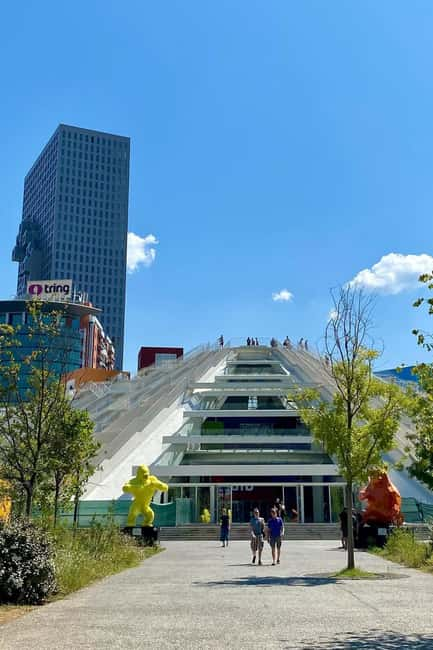
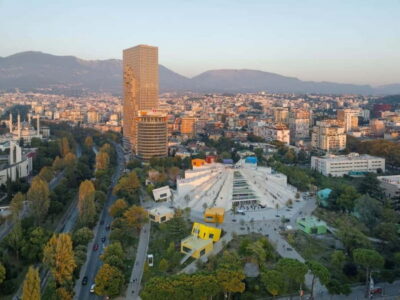
The Pyramid is one of Tirana’s most unusual buildings. Constructed in the 1980s as a museum dedicated to Enver Hoxha, Albania’s communist dictator, it now serves as a center for cultural and social activities.
The tour allows about 20 minutes here. That is enough to take in the structure and hear why it matters, but not enough for a detailed architectural study or a long program inside. The building’s changing role makes it a useful symbol of Tirana itself. A place created to honor a dictator now hosts public and cultural activity.
I like this stop because it avoids treating history as something locked away in a museum. The Pyramid remains part of the city’s daily life. It also helps explain why Tirana can feel visually unusual, with grand political projects placed beside cafes, parks, and modern public spaces.
Mother Teresa Square, the stadium, and the university
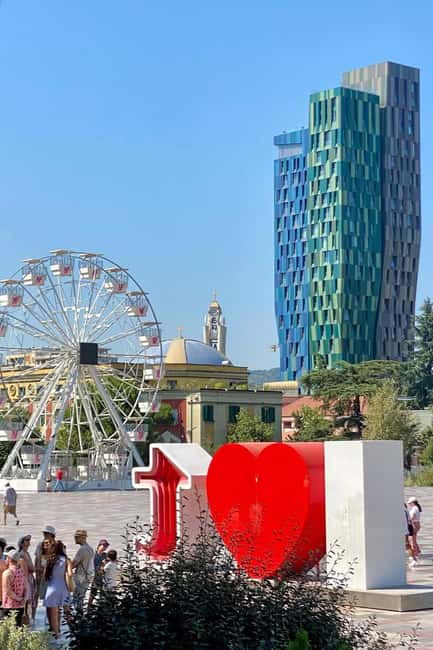
The route continues to Mother Teresa Square, with about 20 minutes scheduled. This broad civic space is connected with several important institutions, including the Archaeological Museum, University Corps, and Air Albania Stadium.
The Archaeological Museum opened in 1948 and displays objects from prehistory through the Middle Ages. It is identified as Albania’s first museum, so even seeing it from the route helps place Tirana at the center of the country’s effort to present its past.
Air Albania Stadium is the national stadium and has been recently renovated. The University Corps is the main campus of the University of Tirana. Together, these sites show a different side of the capital: education, national sport, and public institutions rather than only monuments to earlier rulers.
This section is best treated as a guided orientation. The tour description names the museum, stadium, and university, but the timed itinerary gives the main visit to Mother Teresa Square rather than a long indoor museum stop. If the Archaeological Museum is a priority, plan a separate visit.
Blloku: from restricted quarter to social center
Blloku receives about 30 minutes of guided touring. Today it is associated with restaurants, bars, and modern city life, but its place in Tirana’s story is more complicated.
The area is connected with the former ruling elite and Enver Hoxha’s Villa, his old residence. The villa is now presented as a museum about his life and the dictatorship period. The tour also takes you toward the Taiwan Center in Youth Park, a popular place for walking, eating, and relaxing.
I find this contrast particularly useful. Blloku is not just a cafe district to cross off a list. It lets you see how spaces linked with political power can later become ordinary social areas. You can look at the present-day restaurants and parks while learning what the district once represented.
The schedule is tight, so do not expect a long meal break here. Meals and drinks are not included. If you want time for coffee or lunch, arrange that before or after the tour rather than counting on Blloku to provide a relaxed stop.
Skanderbeg Square and Tirana’s major landmarks
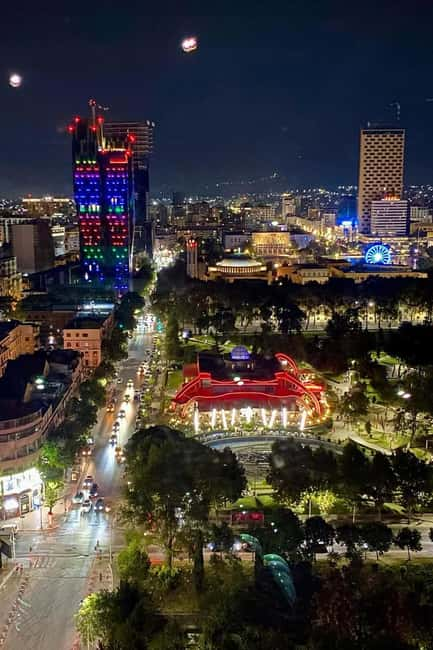
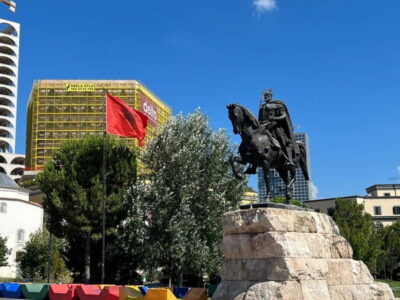
Skanderbeg Square is the grand center of Tirana and receives a short guided visit near the end of the route. The square connects many of the city’s main sights, including the National Historical Museum, Clock Tower, Et’hem Bey Mosque, Orthodox Cathedral, and government district.
The National Historical Museum is Albania’s largest museum and covers the country from antiquity to the modern period. It is an important place, but the walking tour does not allow time for a full museum visit. Think of the stop as a guide-led introduction, then return later if you want to explore the collections properly.
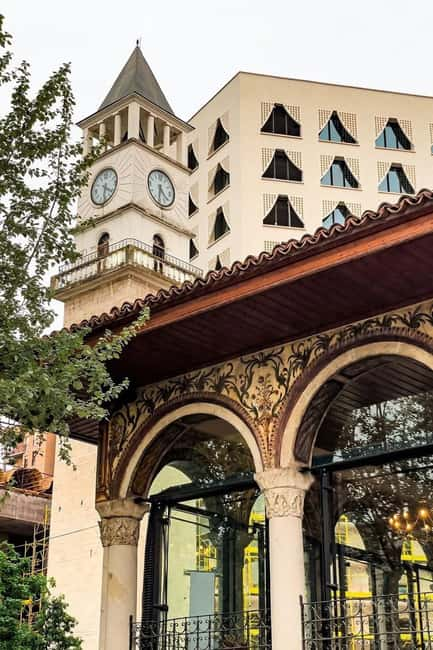
The Et’hem Bey Mosque dates from the end of the 18th century and is known for detailed Ottoman architecture and painted frescoes. Modest dress may be required for entry at some sites, so dress with religious buildings in mind. Even a short look is worthwhile because the mosque gives the square an older, more intimate scale beside the larger civic buildings.
The Clock Tower is one of Tirana’s best-known symbols. The tour includes it as a place for a panoramic view over the central square. That viewpoint adds real value because it lets you see how the square, mosque, museum, and surrounding streets fit together. Check whether the tower access is operating on your date, since the general tour information does not provide separate opening details.
Churches, government buildings, and memories of communism
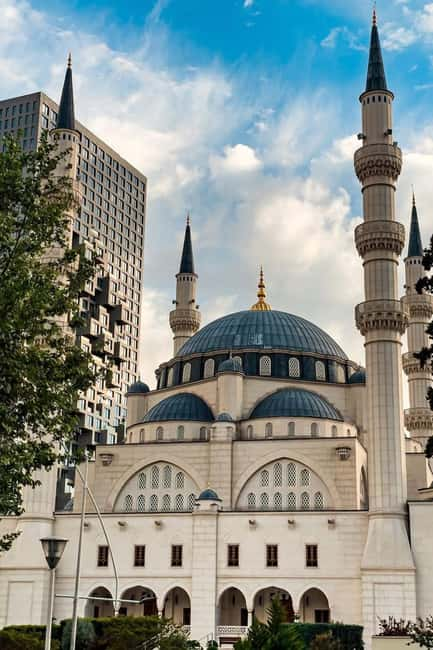
Several important buildings appear as part of the wider city walk. The New Mosque is one of Albania’s largest mosques. The Cathedral of Saint Paul is a Catholic church built in the 2000s, noted for its modern design and the Mother Teresa statue in its courtyard.
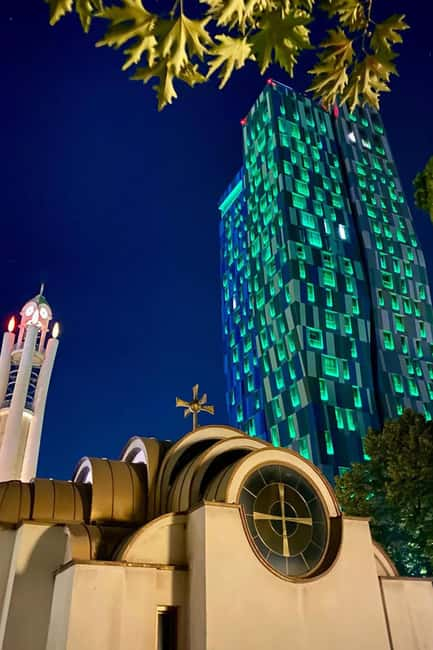
The Resurrection of Christ Cathedral, built in 2012, is the largest Orthodox church in Tirana. Its modern architecture and detailed frescoes add another religious tradition to the route. Seeing these three places together helps you understand the range of faiths and public identities present in the capital.
The Government Complex consists of Albania’s main government buildings, built in a neoclassical style during the fascist period. These buildings remind you that Tirana’s architecture was also shaped by the years when Italy controlled Albania. That is a useful correction to the idea that the city’s past is only Ottoman and communist.
The Postbllok Memorial honors victims of communism. Along with Bunk’Art 2, the House of Leaves, and Enver Hoxha’s Villa, it gives the tour a clear focus on the dictatorship years. The House of Leaves occupies a former State Security investigation center and documents secret-service activity and persecution.
These places can feel like a lot in one afternoon. I would not expect every stop to receive equal depth. The advantage is breadth: you leave with a map of the city’s difficult subjects and can choose which museum deserves a longer return visit.
New Bazaar and the everyday city
The New Bazaar is a recently renovated traditional market. It is a useful counterpoint to the government district and museums because it shows Tirana as a place to shop, eat, and meet, not only a place to study.
The market is included among the city highlights, although the timed itinerary emphasizes Bunk’Art 2, Tanners’ Bridge, the Pyramid, Mother Teresa Square, Blloku, and Skanderbeg Square. Ask your guide how much time is planned for the bazaar on your departure. If it is a priority, you may want to return after the tour for a slower look.
I like having the New Bazaar in the overall route because it connects the past with present-day life. Renovation can make a market feel polished, but the traditional market function still gives you a more grounded view of the city than another grand monument would.
Is $35 a fair price?
At $35 per person, the tour is fairly priced if you want a guide and plan to visit Bunk’Art 2 anyway. The cost includes the three-hour walking tour, live guiding, and the museum entrance. It does not include food, drinks, transport to the meeting point, or personal spending.
The value is strongest for a first day in Tirana. You get a broad orientation, a serious museum visit, a panoramic city view, and explanations that connect landmarks across several centuries. Paying separately for a guide and museum admission could easily make a self-planned visit less simple, even if you can walk the route on your own.
The value is weaker if you prefer slow museum visits or independent wandering. The route covers many places, but the short schedule means you will often see a building, hear its story, and move on. A self-guided day would give you more time at the National Historical Museum, House of Leaves, Archaeological Museum, or the Pyramid.
Practical advice for the walk
Wear comfortable shoes. The route includes long stretches on foot, and the supplied schedule includes a 10-minute walk between Bunk’Art 2 and Tanners’ Bridge before continuing through central Tirana.
Bring water, a card, and some cash. Meals and drinks are not part of the price, and you may want money for a coffee, snack, or personal purchase at the New Bazaar or elsewhere.
Check the forecast and dress for the weather. Much of the experience is outdoors, and a hot or rainy day will affect your comfort. Religious sites may call for modest clothing, so avoid arriving in beachwear.
Photography is allowed, but use courtesy around local people. The tour passes ordinary public spaces as well as museums and monuments, so not every scene is yours to photograph without thought.
Cancellation is free up to 24 hours before departure for a full refund, and you can reserve now and pay later. The activity is offered in Albanian, English, and Italian. Confirm the start time and exact office location before you go, since availability controls the departure schedule.
Who should book this Tirana tour?
I would choose this tour if you have limited time in Tirana, want a strong introduction to the city, or prefer someone else to connect the historical details. It suits people who enjoy seeing many landmarks in one outing and who want Bunk’Art 2 included without arranging a separate visit.
It is also a good fit if communist-era history interests you. Bunk’Art 2, the Postbllok Memorial, House of Leaves, the Pyramid, and Enver Hoxha’s Villa give the tour a more serious edge than a standard city stroll.
I would hesitate if you dislike walking, want a relaxed food-focused outing, or hope to enter every museum and church along the way. The tour is active and broad, not leisurely and deep at every stop.
Should you book it?
Book it if you want an efficient first look at Tirana with Bunk’Art 2 as the main historical anchor. The combination of a live guide, included museum entry, Clock Tower views, Ottoman sights, Blloku, and major squares makes $35 reasonable for a three-hour introduction.
Skip it only if you already know central Tirana well or prefer to spend an entire afternoon inside one or two museums. For most first-time visitors, I would use this tour to get oriented, then return on your own to the National Historical Museum, House of Leaves, New Bazaar, or any place that deserves more time.
FAQ
How long does the Tirana walking tour last?
The activity lasts three hours.
What is included in the price?
The price includes the walking tour of Tirana, a live tour guide, and entrance to Bunk’Art 2.
Is transportation included?
No. Transportation to and from the starting point is not included.
Where does the tour meet?
The meeting point is the Coral Travel & Tours main office. Rruga George W. Bush is identified as the starting and finishing area, so confirm the exact meeting instructions before departure.
What languages are available?
The live guide service is available in Albanian, English, and Italian.
Is Bunk’Art 2 included?
Yes. The Bunk’Art 2 entrance fee is included, with skip-the-ticket-line access.
What should I bring?
Bring comfortable shoes, water, drinks, a credit card, and cash. Dress for the weather, and choose modest clothing in case a religious site requires it.
Just added around Tirana
- Zipline Tirana Adventure & Petrela Castle – With Transport★ 4.4 · 10 reviews
- Wine Tasting & Vineyards Escape near Tirana★ 4.9 · 8 reviews
- Wonderful Sunset and Dinner in the Castel Of Petrela★ 4.6 · 4 reviews
- Walking Tour in Tirana, Albania★ 3.7 · 28 reviews
- Vlora, Dhermi & Llogara Day Trip from Durrës or Golem★ 5.0 · 5 reviews
- From Tirana: Mount Dajti Adventure, Local Vibes & Cable Car opt★ 4.5 · 6 reviews
- Day Tour to Petrela Castle and Zip Line Albania Adventure★ 5.0 · 10 reviews
- Winetasting tour in Alpeta winery – Roshnik village by 1001 Albanian Adventures★ 5.0 · 26 reviews
Walking Tours, compared.

Blue Eye Kayak and walking tour & Lekursi Castle
Read our review →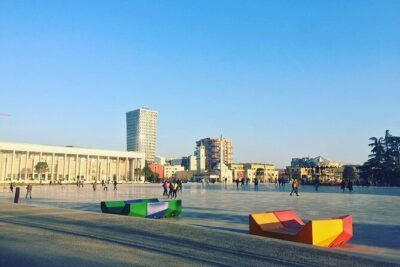

Tirana Stroll Tour, Walk and Taste Qofte & Raki!
Read our review →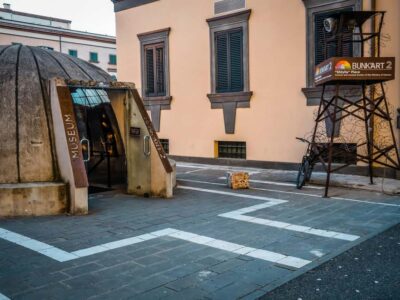
Tirana’s Communist Past; Small Group Walking Tour
Read our review →Browse the lists this tour appears in