
Reviewed · FOOD & DRINK
Tirana Walking Tour, Extra Virgin Olive Oil and Raki Tasting
Tirana’s story comes into focus over a glass of raki. This 2 to 3-hour walk links Skanderbeg Square, the castle, Blloku, and the Pyramid of Tirana with a tasting of extra virgin olive oils and fruit-based rakis. It is a useful first look at a capital shaped by Ottoman rule, Italian planning, communism, and fast change.
I like the local history told on foot, especially the contrast between Enver Hoxha’s former power base and today’s cafes and shops. I also like the tasting, which gives you a direct introduction to Albanian food culture rather than another pass by a monument.
The main caution is reliability. Four of the six published ratings are five stars, but one booking-date error left a customer waiting without a guide. Confirm your date and meeting point before setting out, and allow extra time if your schedule is tight.
In This Review
- Key points to know before booking
- Why the olive oil and raki tasting matters
- Starting under Skanderbeg’s statue
- The Clock Tower and Ottoman Tirana
- Murat Toptani Street connects old and new
- Tirana Castle: old walls, new purpose
- The Italian plan behind Tirana’s grand boulevard
- Blloku, from restricted district to nightlife center
- The Pyramid of Tirana and the city’s communist memory
- What the guide adds to the walk
- Price, pace, and practical value
- Who should book this Tirana walk?
- Should you book it?
- FAQ
- How much does the Tirana Walking Tour, Extra Virgin Olive Oil and Raki Tasting cost?
- How long does the tour last?
- Where does the tour start?
- Where does the tour end?
- What is included in the price?
- Are meals, snacks, or other drinks included?
- Is the tour offered in English?
- What happens if the weather is poor?
Key points to know before booking
- Taste several extra virgin olive oils and fruit rakis: The tasting includes raki made from fruits such as blackberries and plums, with the olive oils.
- See Tirana’s central landmarks in one compact walk: The route covers Skanderbeg Square, the Clock Tower, Tirana Castle, Blloku, and the Pyramid.
- Get context that guidebooks often skip: The walk explains Ottoman Tirana, Italian-led city planning, communist rule, and the city’s modern changes.
- Meet at the Skanderbeg equestrian statue: The tour begins at Sheshi Skënderbej and returns to the same meeting point.
- Expect a small-to-medium walking experience: The activity is described as private for your group, with a maximum capacity of 30 people.
- Pay little for a useful first orientation: At $22.69 per person, the guide and tasting make this a reasonable introduction to central Tirana.
Why the olive oil and raki tasting matters
Many city walks end at a viewpoint or souvenir shop. This one adds a food stop that helps you understand Albania through its table. You taste several extra virgin olive oils, then try different rakis distilled from fruit, including blackberries and plums.
Raki is not one single flavor. The fruit used in distillation changes its character, so tasting several versions side by side gives you more to notice than simply being handed one shot. The experience does not include a meal, snacks, or other drinks, so think of it as a cultural tasting rather than a full food tour.
The tasting has taken place in Tirana Castle, a particularly fitting setting. The castle is now a modern eating and shopping area, but its walls connect the tasting to the older city. I like that pairing: you get a practical introduction to local flavors while sitting in a place tied to Tirana’s past.
If you do not drink alcohol, the olive oil portion still gives the experience value, but the tour’s food element is clearly built around raki. The supplied details do not state that a nonalcoholic substitute is available, so ask before booking if that matters to you.
A few more Tirana trips to weigh up
- Tirana: Traditional Cooking Class with Wine & Raki Tasting
★ 5.0 · 284 reviews - Cooking Classes and Traditional food tasting in Tirana
★ 5.0 · 282 reviews - Traditional Albanian Cooking Class in Tirana & Raki Tasting
★ 5.0 · 266 reviews
Starting under Skanderbeg’s statue
The meeting point is the equestrian statue of Skanderbeg in central Skanderbeg Square. This is a sensible place to begin because the square is hard to miss and puts you directly in the middle of Tirana’s civic story.
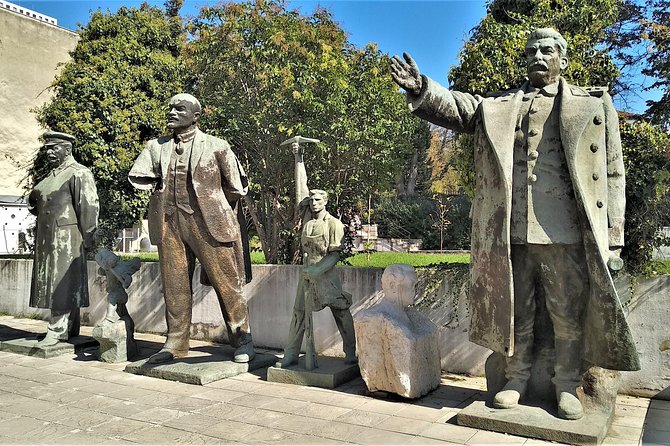
The square was first conceived before the Second World War by Italian architect Armando Brasini. Its political life did not stop there. It later hosted statues of Stalin, Skanderbeg, and Enver Hoxha, but today only Skanderbeg’s statue remains.
Your guide uses the square to explain how its present form developed through repeated political and architectural changes. That background is more useful than simply taking a picture of the statue, because it shows how public spaces in Tirana have been repeatedly remade to match the government of the time.
You spend about 20 minutes here, with no separate admission charge. Look around before the walk begins. The open space gives you a quick sense of Tirana’s scale, while the surrounding buildings show the mix of older Ottoman traces, Italian influence, and later state planning.
The Clock Tower and Ottoman Tirana
The Tirana Clock Tower is one of the city’s oldest structures from the late Ottoman period. Construction was completed in 1822, giving you a fixed date for thinking about Tirana before its twentieth-century political changes.
The stop is brief, but it adds needed balance. Much of central Tirana’s public image comes from communist-era buildings and post-1990 redevelopment. The Clock Tower reminds you that the city existed long before those chapters.
Admission is listed as free for the tour stops. The supplied details do not say that you climb the tower, so do not book this walk expecting an interior visit or a high view. Its role here is mainly historical and visual.
Murat Toptani Street connects old and new
From the square, the route follows the pedestrian Murat Toptani Street. This passage works almost like an open-air corridor through central Tirana, with monuments, public institutions, and newer tourist spots appearing along the way.
The street leads past or near the Fortress of Tirana, the Academy of Sciences, the old National Library, the former Political Persecutor’s Building, and Tanners Bridge. It also connects with places such as the National Gallery of Arts and the residence of Albania’s former royal family.
You will not have time to study every building in detail during a 2 to 3-hour walk. That is the tradeoff. The route gives you a broad introduction and useful pointers for later exploring, but you should return on your own if one site catches your attention.
This part is also a good reason to choose a guide instead of simply following a map. The physical distance between landmarks is easy to cover. The harder part is understanding why a former political building, a royal residence, a pedestrian street, and a repurposed castle sit within the same short walk.
Same coast, a completely different kind of day:
- From Tirana: Bovilla Lake & Gamti Mountain Hiking Day Trip
★ 4.9 · 4,397 reviews - From Tirana: Bovilla Lake & Gamti Mountain Hiking Tour
★ 4.9 · 3,003 reviews - From Tirana: Bovilla Lake & Gamti Mountain Viewpoint Hike
★ 4.8 · 2,053 reviews - Tirana/Durres/Golem: Saranda, Ksamil, Blue Eye Day Trip
★ 4.8 · 1,584 reviews
Tirana Castle: old walls, new purpose
Tirana Castle, or Kalaja e Tiranës, sits along Toptani Pedestrian Street. It is described as one of the city’s newer tourist destinations, and its current use makes it different from a preserved fortress that you visit only for ruins.
The castle area now functions as a contemporary destination, making it a useful example of how Tirana turns older structures into places for present-day life. The tour allows about 15 minutes here, with no separate admission cost listed.
The castle is also connected to the tasting. The setting makes the olive oil and raki stop feel tied to the city rather than bolted onto the end of a sightseeing route. You can ask your guide about the products and about the castle’s place in Tirana’s changing center.
Do not expect a long archaeological visit. Fifteen minutes is enough for orientation and photographs, not for detailed study. If you are especially interested in fortifications, you will want to return later with more time.
The Italian plan behind Tirana’s grand boulevard
The walk also explains the boulevard shaped by Italian architects Armando Brasini and Gherardo Bosio. Brasini gave the project a grand European Renaissance style, while Bosio developed its neoclassical buildings and broader visual order.
The project drew interest from Benito Mussolini, who called both architects to special audiences to discuss the progress of the boulevard. That fact adds a difficult but important layer to Tirana’s appearance. The formal buildings and broad planning were not created in a political vacuum.
I find this kind of explanation valuable because it keeps architecture from becoming mere decoration. A grand boulevard can look impressive, but the guide helps you ask who designed it, under which political system, and for what purpose.
The information provided does not assign a separate stop time to this boulevard section. It appears as part of the walking commentary, so your experience will depend on the guide’s pacing and the group’s questions.
Blloku, from restricted district to nightlife center
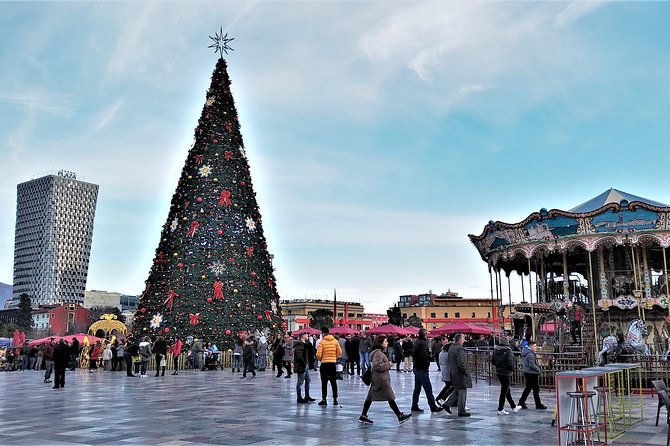
Blloku, also called Ish-Blloku, gives you the sharpest change in atmosphere on the route. Today it is an upmarket district of boutiques, restaurants, bars, pubs, cafes, and shops. It is often described as a playground for Albania’s young elite.
During communism, ordinary Albanians were not allowed into this area. It was a restricted residential zone for members of the Albanian politburo, and Enver Hoxha’s former residence is still here.
That contrast is the point of the stop. You are not just walking through a fashionable neighborhood. You are seeing how a closed political district became one of Tirana’s main entertainment areas after the fall of communism.
The tour allows around 15 minutes in Blloku. That is enough to understand the change and note places to revisit, but not enough for a proper meal or nightlife stop. Since food and drinks beyond the included tasting are excluded, plan separate time if you want to eat here.
Blloku can also help you plan the rest of your stay. If you prefer cafes and modern city life, you may want to return in the evening. If you are more interested in communist history, the former Hoxha residence gives the neighborhood a more serious edge.
The Pyramid of Tirana and the city’s communist memory
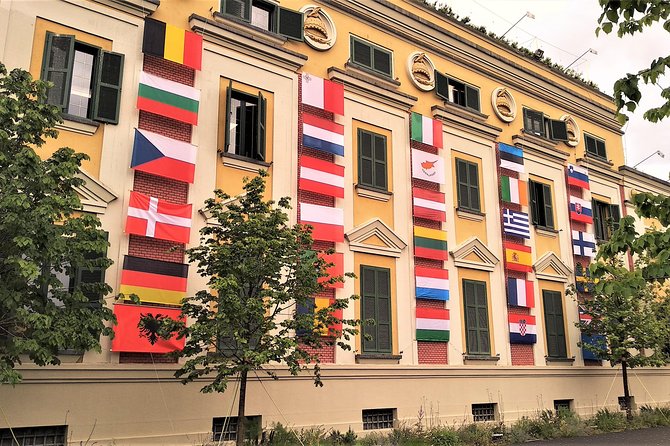
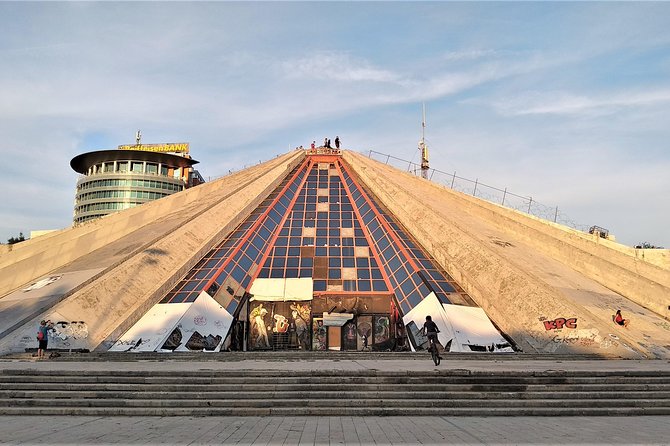
The former Enver Hoxha Museum is one of the most striking stops. It opened in 1988 as a museum dedicated to Albania’s communist leader and served that purpose until 1991.
Its design resembles an Egyptian pyramid, but the shape has another political meaning. Seen from above, it forms a communist star with rays spreading outward. The building was made to honor a leader and an ideology, not simply to house exhibits.
Today, the renewed structure offers a different experience from the one intended by its original designers. The supplied details promise that the renovated building will surprise you, but they do not specify which interior areas are visited or whether admission is included. Treat this as an exterior and historical stop unless your guide tells you otherwise.
The Pyramid is especially useful late in the walk because you have already heard about Hoxha’s former neighborhood in Blloku and the political symbols of Skanderbeg Square. The stops begin to connect. You see how power was displayed in monuments, buildings, neighborhoods, and public space.
What the guide adds to the walk
The strongest part of this experience is the live explanation. A guide can point out the gap between official symbols and everyday life, then connect that gap to what you are seeing around you.
Taulant is named in several of the supplied comments as a guide who explains Albanian history with enthusiasm and offers suggestions for local shops and restaurants. He has also been careful to keep the group in the shade when possible and has shared time over coffee during a walk. That is useful practical behavior in Tirana’s warmer months, though you should not assume Taulant will lead every departure.
The experience is offered in English and includes a professional certified guide. The format is described as private for your own group, while the maximum capacity is 30 people. That wording suggests you should check the booking details if you require a genuinely exclusive walk for only your party.
A guide can also adjust the conversation to your interests. You might ask about the Ottoman period, Italian architecture, the communist leadership, or the post-1990 changes in Blloku. The walk is short enough to stay manageable, but long enough for questions.
Price, pace, and practical value
At $22.69 per person, this is modestly priced for a guided city walk with a tasting included. I see the best value in the combination: you get an orientation to central Tirana, explanations at major sites, and a chance to try local olive oils and rakis without paying for a separate food experience.
The tour lasts about 2 to 3 hours. That makes it a good first-day activity, especially if you want help finding your bearings before exploring independently. It is also short enough to fit between other plans.
You will be walking through central Tirana, so comfortable shoes and water are sensible. A past guide kept to shaded areas when possible, but shade is not guaranteed. The tour requires good weather, and poor conditions can lead to a different date or a full refund.
Public transportation is nearby, and most people can participate. The start and end point are the same, at Skanderbeg’s statue. That makes the activity easier to combine with other plans in the center.
Free cancellation is available up to 24 hours before the start time for a full refund. Changes or cancellations inside that 24-hour window are not accepted for a refund.
One practical issue deserves attention. A customer once arrived for an amended booking date that had not appeared on the operator’s schedule, and the guide did not show. The operator accepted a full refund and said the booking change was their error. That appears to have been a specific scheduling mistake, not the normal experience, but I would still save the confirmation and verify any changed date directly.
Who should book this Tirana walk?
I would choose this tour if you are visiting Tirana for the first time and want history explained in plain language. It suits you if you like seeing major landmarks without spending half a day inside museums, and if local drinks and food traditions interest you.
It is also a good fit for couples, families, and small groups that want a guided introduction at a low per-person price. The private-group format may give you more freedom to ask questions and set a comfortable pace, though the maximum capacity can reach 30.
You may want a different activity if your main goal is a long museum visit, a full meal, or a serious raki tasting with extensive food pairings. This is a compact city orientation with one tasting, not a full-day history course or restaurant crawl.
Should you book it?
Book it if you want central Tirana in one readable route, with the added pleasure of olive oil and fruit raki in the castle. The strongest reasons are the guide’s local perspective, the clear contrast between Blloku’s communist past and modern life, and the chance to understand why the Pyramid and Skanderbeg Square look the way they do.
I would be cautious only if your schedule cannot tolerate a meeting problem or if you expect detailed entry into every landmark. Confirm the date, arrive at the Skanderbeg statue, and view the experience as a smart first orientation rather than a complete tour of Tirana.
FAQ
How much does the Tirana Walking Tour, Extra Virgin Olive Oil and Raki Tasting cost?
The price is $22.69 per person. Group discounts are listed as available, but the supplied details do not state the discount amount.
How long does the tour last?
The experience lasts approximately 2 to 3 hours.
Where does the tour start?
The meeting point is the equestrian statue of Skanderbeg at Sheshi Skënderbej in Tirana.
Where does the tour end?
The activity ends back at the same meeting point.
What is included in the price?
A professional certified guide and a tasting of extra virgin olive oils and different rakis are included. The rakis may be distilled from fruits such as blackberries and plums.
Are meals, snacks, or other drinks included?
No. Meals, snacks, and drinks other than the included tasting are excluded.
Is the tour offered in English?
Yes. The tour is offered in English.
What happens if the weather is poor?
The experience requires good weather. If it is canceled because of poor weather, you will be offered a different date or a full refund. Free cancellation for a full refund is also available when you cancel at least 24 hours before the start time.
Just added around Tirana
- Zipline Tirana Adventure & Petrela Castle – With Transport★ 4.4 · 10 reviews
- Wine Tasting & Vineyards Escape near Tirana★ 4.9 · 8 reviews
- Wonderful Sunset and Dinner in the Castel Of Petrela★ 4.6 · 4 reviews
- Walking Tour in Tirana, Albania★ 3.7 · 28 reviews
- Vlora, Dhermi & Llogara Day Trip from Durrës or Golem★ 5.0 · 5 reviews
- From Tirana: Mount Dajti Adventure, Local Vibes & Cable Car opt★ 4.5 · 6 reviews
- Winetasting tour in Alpeta winery – Roshnik village by 1001 Albanian Adventures★ 5.0 · 26 reviews
- Day Tour to Petrela Castle and Zip Line Albania Adventure★ 5.0 · 10 reviews
Food & Drink, compared.
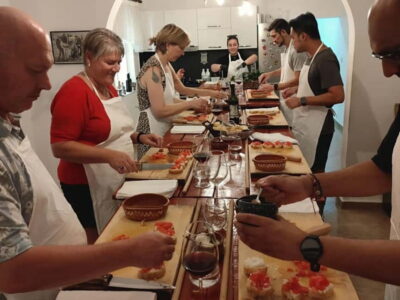
Traditional Cooking Class with Wine & Raki Tasting
Read our review →
Cooking Classes and Traditional food tasting in Tirana
Read our review →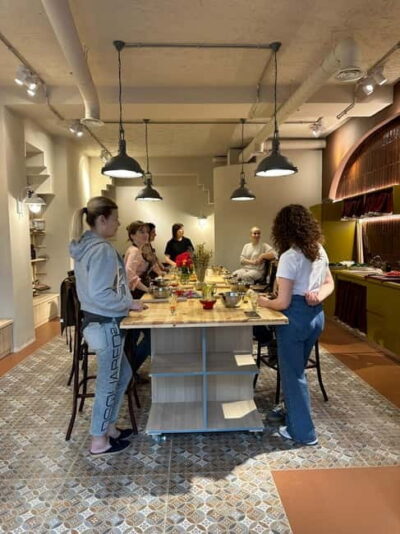
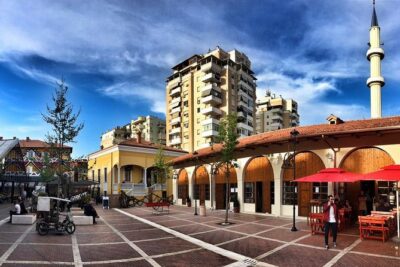
Traditional Albanian Cooking Class in Tirana & Raki Tasting
Read our review →
Best of Local Food & City Tour of Tirana – Food & Drinks Included
Read our review →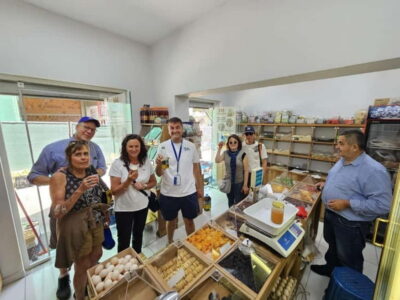
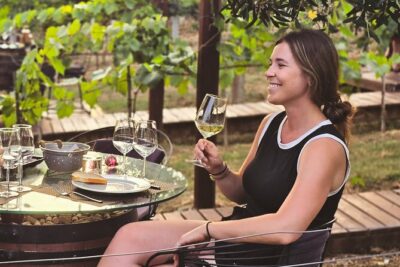
Durrës Countryside Vineyard Experience with Wine & Food Pairing
Read our review →
Traditional Albanian Cooking Class in Tirana with Raki Tasting
Read our review →Browse the lists this tour appears in