
Reviewed · HISTORICAL TOURS
Cultural Tour in Tirana including House of Leaves
Tirana’s past comes into sharp focus at the House of Leaves, a former secret-police headquarters where rooms, equipment, and surveillance stories show how communist rule reached into private life. That serious visit is balanced by art at Sali Shijaku’s 300-year-old villa and everyday scenes at the New Bazaar.
I like the small group size, capped at 10, because it should make questions and conversation easier. I also like the range: national heroes, Ottoman remains, religious buildings, communist memory, modern art, and local food culture all appear in one half-day outing.
The main consideration is pace. Four hours covers a lot, and several stops receive only 10 to 30 minutes. Some sites may also be closed, as happened on one outing, although guide Gjuljana kept the tour moving and did not shorten the experience.
In This Review
- Key points to know before booking
- Why the House of Leaves gives this tour its character
- Skanderbeg Square puts modern Tirana in context
- Religious buildings show Tirana’s changing identity
- Sali Shijaku Villa brings art into an old Tirana home
- New Bazaar offers a look at daily Tirana
- Tanners’ Bridge is small but worth the pause
- Communist memory continues at the Pyramid and Postbllok
- FAB Gallery adds a younger artistic voice
- What the four-hour format means for you
- Is $58.18 a fair price?
- Who should book this Tirana walk?
- Final verdict: a strong first look at Tirana
- FAQ
- Where does the tour begin?
- Where does the tour end?
- How long does the experience last?
- How much does the tour cost?
- How large is the group?
- Is entry to House of Leaves included?
- Is admission to Sali Shijaku House included?
- What happens if I need to cancel?
Key points to know before booking
- House of Leaves gives the tour its strongest historical focus, examining surveillance and state control during Albania’s communist era.
- Sali Shijaku’s villa is a rare art stop, set inside a traditional 300-year-old Tirana home.
- The group is limited to 10 people, a useful size for a walking tour with several indoor visits.
- The route mixes major sights with smaller stops, including Tanners’ Bridge, Postbllok, and the FAB Gallery.
- Admissions are included at key paid sites, including House of Leaves and Sali Shijaku House.
- The $58.18 price is best for visitors who want context, not just a quick list of photo stops.
Why the House of Leaves gives this tour its character
Many city tours begin and end with grand squares and attractive buildings. This one earns its strongest material inside a former secret-police headquarters.
The House of Leaves now explains how people were watched, recorded, and punished under Albania’s communist state. That makes it more than a standard museum stop. You get a direct look at the machinery of fear and the way ordinary private life could become a matter for government surveillance.
Plan for about one hour here. That is a useful amount of time, but you may still want to read carefully and pause at the displays. The subject is heavy, and the museum works best when you do not rush from room to room.
I find this stop especially useful if you are still trying to understand Albania’s 20th-century past. Other Tirana museums may introduce the communist period, but House of Leaves keeps the focus on secret policing and the people affected by it.
This is also where a good guide matters. Gjuljana has been praised for explaining places with care and enthusiasm, and her role is important here. The building and displays carry weight, but the historical links help you understand what you are seeing.
A few more Tirana trips to weigh up
- From Tirana: Durres History Trip with Beach or Promenade
★ 4.8 · 455 reviews - Guided tour in Tirana – discoveries, history, culture (in FRENCH)
★ 5.0 · 204 reviews - From Tirana: Durres city & Golem beach, Sun & History Day Trip
★ 5.0 · 134 reviews
Skanderbeg Square puts modern Tirana in context
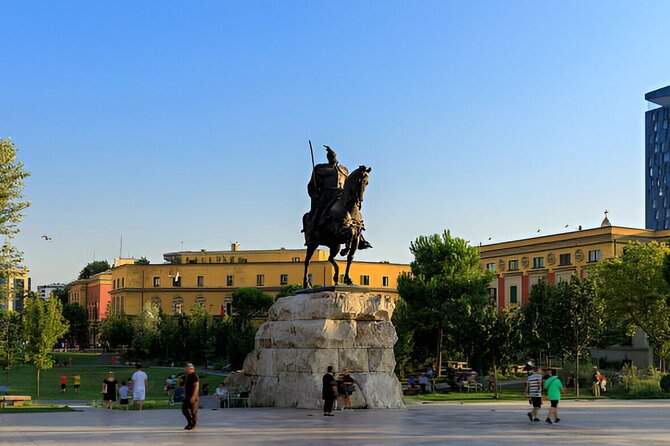
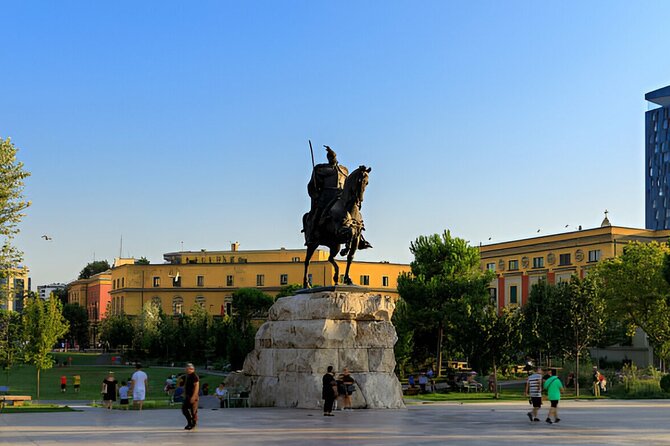
The tour begins at Skanderbeg Square, the broad central plaza named for Albania’s national hero, Gjergj Kastrioti, better known as Skanderbeg.
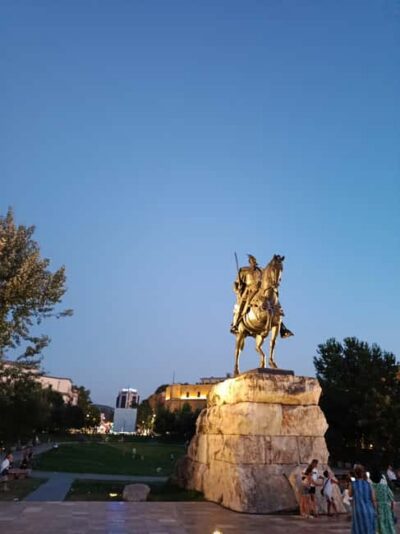
At the center is the large Skanderbeg statue. Around it are the Opera and Ballet Theater, the National Library, government buildings, and neo-Renaissance architecture. Allow about 20 minutes for this opening view.
That short introduction works well. You get your bearings without spending the whole morning on one square. The guide can also explain why the plaza matters as a civic center, rather than treating it as just a place to take a photograph.
The scale can feel imposing, especially when compared with the older lanes and low buildings you visit later. That contrast is part of the appeal. Tirana shifts quickly between monumental public spaces, Ottoman-era traces, communist projects, and newer commercial districts.
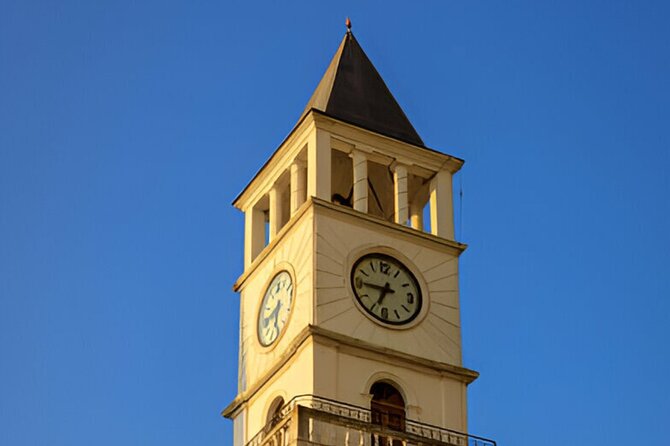
The route may also include the Et’hem Bey Mosque and Tirana Clock Tower. The mosque is known for detailed frescoes and has a special place in Albania’s return to religious freedom and democracy. The clock tower offers a view over the city if access is open. Since opening conditions can change, ask your guide early about which interiors and climbs are available that day.
Religious buildings show Tirana’s changing identity
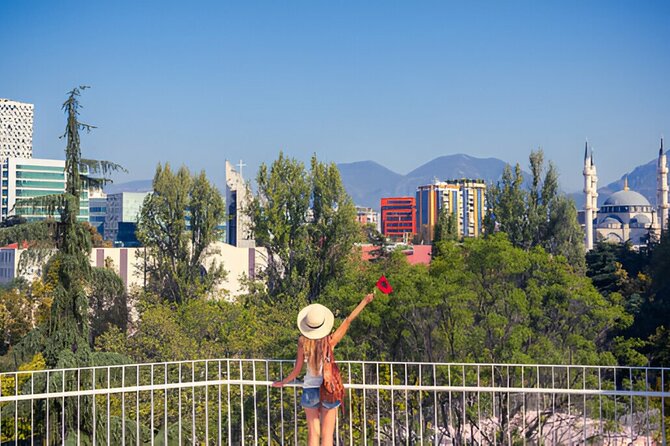
The Et’hem Bey Mosque is a calm counterpoint to the large square around it. Its painted decoration gives you a closer look at Tirana’s older artistic traditions, while its modern political importance links religion to the country’s path toward democracy.
The tour may also pass the Great Mosque of Tirana, also called the Namazgah Mosque. The building was still under construction in the information provided for this experience, so treat it as an exterior point of interest rather than a guaranteed interior visit.
St. Paul’s Cathedral offers a different architectural note. It is a relatively new building, but its distinctive form has made it a recognizable Catholic landmark in the capital. The planned visit lasts about 15 minutes, enough for a short look and a little context without turning the tour into a formal religious architecture study.
These stops are brief, but they help you see that Tirana is not defined by one faith, one period, or one building style. The value is in the comparison: mosque, cathedral, Ottoman bridge, communist memorial, and contemporary gallery all appear within the same city walk.
Dress and behave respectfully at religious sites. The supplied details do not specify a formal dress code, so your guide is the best source of advice on the day.
Sali Shijaku Villa brings art into an old Tirana home

The House of Sali Shijaku is one of the tour’s most unusual stops. Rather than entering a purpose-built museum, you visit a 300-year-old traditional villa where the painter Sali Shijaku lived and worked.
The visit lasts about 30 minutes. That is enough to see the setting and several works, though art lovers may wish for more time. The house itself is part of the attraction. Its age and traditional character give the paintings a setting that feels personal, not institutional.
One early image described at the villa shows two roosters facing each other in a lively allegorical scene. Expect strong color and expressive subjects rather than a quiet collection of anonymous museum pieces.
Sali Shijaku is presented as one of Albania’s major 20th-century painters. You do not need detailed art training to enjoy this stop. The guide’s explanation can help you connect the paintings with Albanian culture and with the artist’s own home.
This is a good example of why the tour is broader than a standard sightseeing circuit. You are not only checking off a gallery. You are seeing art in a house tied to the artist, with the building itself acting as part of the story.
Same coast, a completely different kind of day:
- From Tirana: Bovilla Lake & Gamti Mountain Hiking Day Trip
★ 4.9 · 4,397 reviews - From Tirana: Bovilla Lake & Gamti Mountain Hiking Tour
★ 4.9 · 3,003 reviews - From Tirana: Bovilla Lake & Gamti Mountain Viewpoint Hike
★ 4.8 · 2,053 reviews - Tirana/Durres/Golem: Saranda, Ksamil, Blue Eye Day Trip
★ 4.8 · 1,584 reviews
New Bazaar offers a look at daily Tirana
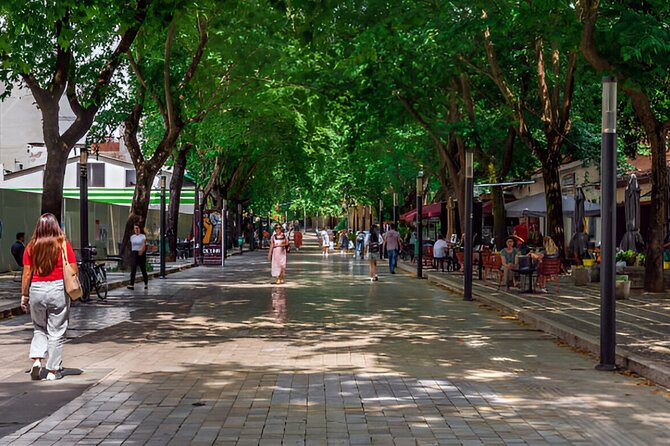
Pazari i Ri, or the New Bazaar, is one of the more social parts of the route. The area was once an old residential neighborhood and has since been renovated, while keeping its market identity.
At the center, local farmers sell fruit, vegetables, meat, seafood, spices, and other produce. The market is a useful place to watch ordinary commerce and see how Tirana’s older food traditions fit into a refreshed public space.
The stop lasts about 30 minutes. That gives you time to look around, but not necessarily to shop at length or settle in for a full meal. If you see something you want to buy, ask the guide how much free time is available before wandering off.
I like the balance here. After the serious subject of House of Leaves and the formal monuments around Skanderbeg Square, the bazaar gives you a more ordinary view of the city. You see what people sell, how the neighborhood has changed, and how public spaces are being reused.
The market’s renovation is also worth noting. Traditional elements remain, but the square has a cleaner, newer appearance. That mixture reflects Tirana itself, a city changing quickly while still holding onto older layers.
Tanners’ Bridge is small but worth the pause

Tanners’ Bridge is a short stop, around 10 minutes, and it will not fill a major part of your day. Still, the Ottoman-era stone bridge offers a useful clue to the Tirana that existed before modern streets surrounded it.
Built in the 1700s, the bridge now appears slightly out of place among city traffic and newer construction. That odd setting is the point. You can see how the city has grown around an older piece of infrastructure.
Do not book this tour expecting a grand monument at every stop. Tanners’ Bridge is modest. Its value comes from the connection it creates between Tirana’s Ottoman past and its present-day urban form.
Communist memory continues at the Pyramid and Postbllok
The Pyramid of Tirana is one of the city’s most recognizable communist-era structures. It was built as a museum dedicated to dictator Enver Hoxha shortly before communism fell.
Since then, the building has had several uses, including a period as a NATO base during the Kosovo War. Work was underway to turn it into a youth cultural center, so the appearance and access can change over time.
The planned visit lasts about 15 minutes. That makes it a quick exterior and context stop, not a full building tour. The Pyramid is still worth seeing because its shape and original purpose say a great deal about how political power once presented itself.
Postbllok, also called the Checkpoint Monument, adds a more direct memorial to repression. Its three-part design includes concrete girders taken from Spaç Prison, where political prisoners were held. The girders are arranged as they were in the prison halls.
This stop takes about 20 minutes. It is not decorative public art. The materials connect a central Tirana memorial with a prison site and the experience of those who suffered there.
Together, the Pyramid and Postbllok help frame the House of Leaves. One shows how a regime represented itself. The other points toward imprisonment and political punishment. If you want only cheerful sightseeing, this section may feel stark. If you want to understand Tirana beyond its cafes and plazas, it is essential.
FAB Gallery adds a younger artistic voice

The FAB Gallery is part of Tirana’s University of Arts and supports students and young artists. Exhibits may include painting, photography, and short films, with a different event often appearing from week to week.
The gallery is open to everyone, and entry is usually free. The visit is planned for about 30 minutes. Because the program changes, the exact experience cannot be guaranteed in advance.
You may find colorful abstract graffiti on the walls and a show that feels more experimental than the Sali Shijaku villa. That contrast is useful. The villa connects you with an established Albanian painter and a historic home, while FAB shows the work of artists still building their careers.
The gallery is also a reminder that Tirana’s art scene is not limited to famous names and old collections. If a current exhibition is running, it can add a contemporary edge to a route otherwise weighted toward history.
What the four-hour format means for you
This is a full half-day, not a slow museum day. The route includes several short stops, one longer museum visit, and enough movement to connect neighborhoods and city landmarks.
A small group of no more than 10 is a real advantage. You should have a better chance of hearing explanations and asking about places that catch your eye. It also makes a walking-based cultural tour feel more personal than a large coach excursion.
The tradeoff is limited time at certain sites. Sali Shijaku Villa, FAB Gallery, St. Paul’s Cathedral, the Pyramid, and Tanners’ Bridge each receive a short visit. If one place especially interests you, note it and return later on your own.
The tour begins and ends at Skanderbeg Square. Its stated operating period is Monday through Sunday, from 9:00 a.m. to 5:00 p.m. The mobile ticket is convenient, and confirmation is provided when you book.
The route is near public transportation, and most people can participate. Service animals are allowed. It is not recommended for people over 95, according to the supplied participation information.
One practical warning: access can change. A previous outing had some sites closed, but the guide continued with the day and did not cut the tour short. That is reassuring, but you should still view the experience as a guided city walk with several planned stops, not a guarantee that every interior will be open.
Is $58.18 a fair price?
At $58.18 per person, this is not the cheapest way to see Tirana’s central sights. The value depends on how much explanation and structure you want.
If you visited only the public spaces and exterior landmarks, you could spend less. Skanderbeg Square, Pazari i Ri, Tanners’ Bridge, the Pyramid, and Postbllok do not require the same level of paid admission listed for the museum and villa.
The price makes more sense when you count the included admissions to House of Leaves and Sali Shijaku House, plus the guide’s time and the route planning. You are also getting places that are easy to miss if you simply follow the main tourist circuit.
I would consider it good value for a first visit, especially if you have only a few days in Tirana and want the city’s political, artistic, religious, and everyday sides explained in one outing. It is less compelling for a repeat visitor who already knows the central sights and prefers to spend an hour or two at each museum.
The 14-day advance booking pattern suggests that planning ahead is sensible, particularly if you need a particular date. Free cancellation is available up to 24 hours before the start time. Cancellations or changes inside that window are not refunded or accepted.
Who should book this Tirana walk?
I would choose this tour if you want context rather than just photographs. The strongest parts are House of Leaves, Postbllok, and the link between communist memory and the Pyramid.
It also suits you if you enjoy smaller museums, local art, and older neighborhoods. Sali Shijaku Villa and FAB Gallery give the day more personality than a route built only around famous monuments.
The tour may be less suitable if you want a relaxed food tour, extended shopping time, or long visits inside every building. Its schedule is active, and several stops are brief.
Families with older children may appreciate the mix of visual places and clear historical themes, but the House of Leaves and Postbllok can be emotionally difficult. Consider your group’s interest in political history before booking.
Final verdict: a strong first look at Tirana
I recommend this experience for a first visit when you want to understand how Tirana became the city you see today. The route moves from Skanderbeg’s national symbolism to communist surveillance, from a painter’s old home to a modern market, with religious landmarks and memorials filling the gaps.
Its best feature is the range, backed by a small group and a guide such as Gjuljana, who can add meaning when a building or memorial needs more than a quick glance. Its main weakness is the pace, since no single site receives enough time for a truly thorough visit.
Book it if you value a guided overview and want House of Leaves and Sali Shijaku Villa built into your day. Skip it if you prefer to explore slowly and independently. For most first-time visitors, the combination of included admissions, varied stops, and a four-hour format makes it a practical introduction to Tirana.
FAQ
Where does the tour begin?
The tour begins at Skanderbeg Square, Sheshi Skënderbej, in Tirana.
Where does the tour end?
The activity ends back at the meeting point at Skanderbeg Square.
How long does the experience last?
The tour lasts approximately four hours.
How much does the tour cost?
The listed price is $58.18 per person.
How large is the group?
The tour has a maximum of 10 participants.
Is entry to House of Leaves included?
Yes. Admission to House of Leaves is included.
Is admission to Sali Shijaku House included?
Yes. Admission to Sali Shijaku House is included.
What happens if I need to cancel?
You can receive a full refund if you cancel at least 24 hours before the experience start time. Cancellations and changes made less than 24 hours before the start time are not refunded or accepted.
Just added around Tirana
- Zipline Tirana Adventure & Petrela Castle – With Transport★ 4.4 · 10 reviews
- Wine Tasting & Vineyards Escape near Tirana★ 4.9 · 8 reviews
- Wonderful Sunset and Dinner in the Castel Of Petrela★ 4.6 · 4 reviews
- Walking Tour in Tirana, Albania★ 3.7 · 28 reviews
- Vlora, Dhermi & Llogara Day Trip from Durrës or Golem★ 5.0 · 5 reviews
- From Tirana: Mount Dajti Adventure, Local Vibes & Cable Car opt★ 4.5 · 6 reviews
- Winetasting tour in Alpeta winery – Roshnik village by 1001 Albanian Adventures★ 5.0 · 26 reviews
- Day Tour to Petrela Castle and Zip Line Albania Adventure★ 5.0 · 10 reviews
Historical Tours, compared.
Guided tour in Tirana – discoveries, history, culture (in FRENCH)
Read our review →
Durres city & Golem beach, Sun & History Day Trip
Read our review →
Tirana Walking Tour: History, Culture &Gems by a Passionate Guide
Read our review →
Semi – Private Tour at Cape of Rodon; Hidden Beaches & History
Read our review →

Ancient City of Butrint, UNESCO World Heritage site – A Must
Read our review →Browse the lists this tour appears in